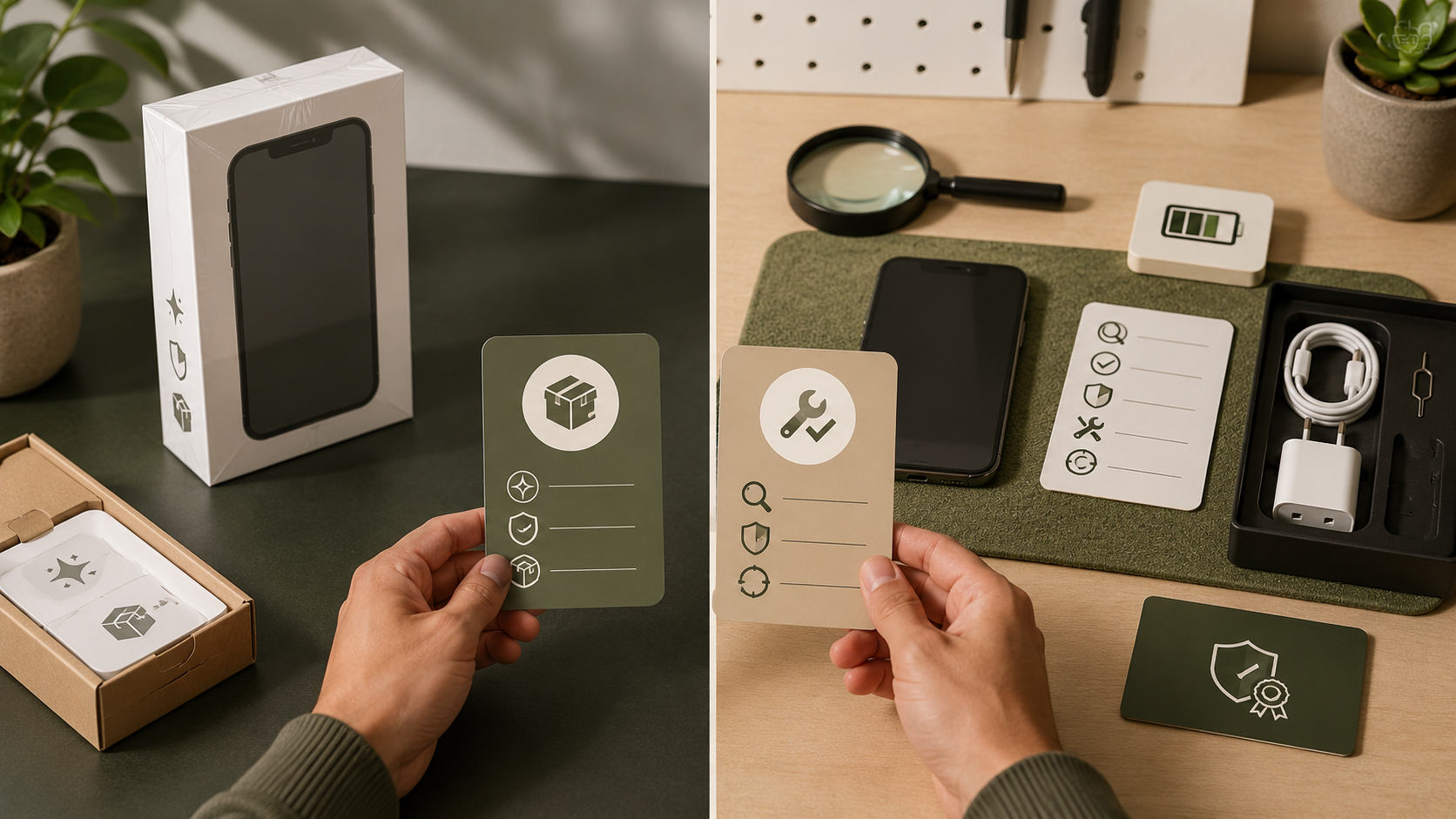
Refurbished vs New: What to Check Before Choosing
A refurbished product can be a smart buy. It can also be a headache in a cheaper box.
That is the honest answer.
A new product usually gives you the cleanest buying experience: fresh packaging, full accessories, clear warranty, easier returns, and less uncertainty. A refurbished product can cost less, reduce waste, and still work well, but only if you understand exactly what you are buying.
The problem is that “refurbished” is not one single condition. It may mean a customer return, an open-box item, a repaired product, a display unit, a renewed device, or a used item that was cleaned and tested. Different sellers use different words: renewed, certified refurbished, seller refurbished, open box, pre-owned, used like new, restored, reconditioned.
Those words are not equal.
Before choosing refurbished over new, do not ask only, “How much cheaper is it?”
Ask:
Who refurbished it?
What condition is it in?
What warranty do I get?
Can I return it if something is wrong?
Are all accessories included?
What is the battery condition, if relevant?
What is the real saving after risk and missing extras?
Is the seller trustworthy?
Is this a product category where refurbished makes sense?
That is the comparison that matters.
The Quick Difference
New
A new product is usually unused, sold in original packaging, with standard accessories and manufacturer warranty, depending on the seller and product.
New is usually better when you need:
full warranty
lowest risk
gifting condition
latest model
sealed packaging
long product life
manufacturer support
predictable return process
Refurbished
A refurbished product has usually been returned, used, opened, inspected, repaired, cleaned, or tested before resale. The exact process depends on the seller.
Refurbished can be better when:
the discount is meaningful
the seller is reliable
the warranty is clear
the return window is practical
condition is described honestly
battery or wear details are disclosed
accessories are included or easy to replace
the product does not create safety or hygiene concerns
The best refurbished purchase is not the cheapest one. It is the one with the least uncertainty.
First Question: Why Is This Product Refurbished?
This is the question most buyers skip.
A refurbished item may exist because:
the original buyer returned it without heavy use
the box was damaged
the item had a minor defect and was repaired
the item was used as a display unit
the product was traded in
the product was cleaned, tested, and resold
the product was repaired with replacement parts
the item was overstock or open-box
Some of these are low-risk. Some are not.
An open-box product returned unused may be very close to new. A repaired product with heavy prior use is a different situation.
The product page should explain condition clearly. If it only says “refurbished” with no detail, treat that as a warning sign.
Refurbished Is Not Always the Same as Used
Used usually means someone owned and used the product, and it may be sold as-is.
Refurbished should mean the product has been inspected, tested, cleaned, repaired if needed, and prepared for resale. But because sellers use terms differently, you should verify the process.
Look for words like:
tested
inspected
cleaned
repaired
certified
graded condition
warranty included
return eligible
battery health disclosed
accessories included
Be careful with vague phrases like:
fully checked
good condition
premium renewed
best quality
like new
seller assured
working perfectly
Those phrases are not enough. You need details.
Check 1: Seller Reputation
For refurbished products, the seller matters almost as much as the product.
A good seller explains:
product condition
testing process
warranty
return window
accessories included
battery condition, if relevant
cosmetic grading
who handles support
whether the product is manufacturer refurbished or seller refurbished
A weak seller hides behind vague language and low price.
Before buying, check:
seller name
seller rating
number of reviews
recent complaints
return handling feedback
warranty claim feedback
contact options
whether the seller is authorized, where relevant
how long the seller has been active
Do not trust only the marketplace rating. Read negative reviews that mention warranty, refunds, wrong condition, missing accessories, fake accessories, battery problems, or poor support.
Example
A refurbished phone from a known manufacturer store with one-year warranty is not the same risk as a refurbished phone from an unknown marketplace seller with a seven-day return window and no battery information.
Both may say “refurbished.” They are not equal.
Check 2: Warranty Terms
Warranty is where many refurbished deals become weak.
Before buying, check:
warranty length
who provides the warranty
what is covered
what is excluded
whether parts and labor are included
whether battery is covered
whether accessories are covered
whether buyer pays shipping
whether service is local or mail-in only
whether registration is required
FTC consumer warranty guidance says buyers should read what is covered, what is not covered, how long coverage lasts, and what the company will do if the product fails. That applies strongly to refurbished purchases because coverage may be shorter or narrower than new-product coverage.
Do not assume refurbished warranty equals new warranty. Sometimes it does. Often it does not.
Check 3: Return Policy
Return policy is your safety net in the first days after delivery.
A warranty helps if the product fails under covered conditions. A return policy helps if the item arrives in worse condition than described, has a hidden issue, does not fit your need, or fails your first tests.
Check:
return window
refund or replacement option
opened-item rules
restocking fee
return shipping cost
pickup availability
condition requirements
original packaging requirement
deadline for reporting damage or wrong item
FTC consumer guidance advises checking refund and return policies before buying, including whether you must pay return shipping or restocking fees.
For refurbished products, a return window matters because some faults appear only after real use. A laptop may seem fine for one hour but heat up after longer use. A phone may work well until the battery drains unusually fast. A speaker may sound fine at low volume but distort at higher volume.
If the product has no return option and only a very short seller promise, the price should be extremely attractive to justify the risk. For most buyers, it is better to avoid unclear return terms.
Check 4: Battery Health
Battery condition matters for:
phones
laptops
tablets
wireless headphones
smartwatches
cameras
power banks
cordless appliances
electric toothbrushes
rechargeable tools
Batteries wear out with use. A product can look excellent outside but have weak battery life.
Ask:
Is battery health disclosed?
Was the battery replaced?
Is there a minimum battery capacity guarantee?
Is battery covered under warranty?
Can the battery be replaced later?
What does replacement cost?
Is the battery original, compatible, or third-party?
Does the seller allow return if battery performance is poor?
For phones and laptops, battery health is one of the most important refurbished checks. If the seller does not disclose it, you are taking a guess.
Example
A refurbished phone is ₹6,000 cheaper than new, but the battery health is low and replacement will cost ₹3,000 soon. The real saving is not ₹6,000. It is closer to ₹3,000, plus the inconvenience of repair.
Check 5: Accessories and Missing Items
New products usually include standard accessories, though even new products can vary by brand and model. Refurbished products may come with missing, generic, or non-original accessories.
Check whether it includes:
charger
cable
adapter
remote
manuals
mounting parts
trays
jars
ear tips
case
stylus
screws or installation kit
original box
warranty card
For some products, missing accessories are minor. For others, they change the real cost.
Example: A refurbished appliance looks ₹2,000 cheaper, but it is missing an installation kit or key accessory that costs ₹1,200. The saving is smaller than it looked.
Also check whether replacement accessories are easily available. If a rare remote, charger, jar, or battery pack is hard to find, think carefully.
Check 6: Condition Grade
Many refurbished sellers use condition grades, but grading is not universal.
Common style of grading may include:
excellent
very good
good
acceptable
open box
certified refurbished
renewed
seller refurbished
Do not rely only on the grade name. Read what it means.
Check:
scratches
dents
screen marks
keyboard shine
hinge condition
ports
buttons
speaker condition
camera lens
charging port
display brightness
dead pixels
water damage history
repaired parts
If buying online, product photos should show actual condition where possible. Stock photos are not enough for condition-sensitive items.
Check 7: Model Age and Software Support
A refurbished product may be cheaper because it is older.
That is not automatically bad. But for electronics, age matters.
Check:
release year
current price of new equivalent
software update support
security update support
app compatibility
spare part availability
repair cost
resale value
whether the model is discontinued
A three-year-old phone may still be useful for basic tasks, but it may not receive updates for as long as a newer model. A laptop may still work well, but battery, storage, and operating-system support should be checked.
Do not buy an older product only because it was expensive when new. Old premium is not always better than current mid-range.
Check 8: Realistic Savings
A refurbished deal should save enough to justify the trade-off.
Calculate real saving like this:
New product price
minus refurbished price
minus missing accessories
minus likely repair or battery replacement
minus extra warranty cost
minus return shipping risk
equals realistic saving
If the realistic saving is small, buy new.
Example
New headphones: ₹8,000
Refurbished headphones: ₹6,800
Missing case replacement: ₹700
Shorter warranty: meaningful risk
Return shipping: buyer pays
Realistic saving: maybe ₹500 to ₹800 after hassle.
That may not be worth it.
Better example
New laptop: ₹62,000
Certified refurbished laptop: ₹46,000
Battery health disclosed
One-year seller warranty
Return window available
Charger included
Condition clearly described
Realistic saving: meaningful enough to consider.
Products Where Refurbished Can Make Sense
Refurbished may be worth considering for:
laptops
desktops
monitors
tablets
phones from reliable sellers
cameras
gaming consoles
office chairs, if returnable
small appliances, if warranty and condition are clear
tools, if inspected and not heavily worn
These can work if the seller is reliable and the discount is strong.
Products Where New May Be Safer
New is usually safer for:
products with hygiene concerns
baby products where safety history matters
helmets and protective gear
mattresses without clear return and hygiene process
heavily battery-dependent devices with no battery disclosure
products with unclear repair history
items without return rights
products from unknown sellers
appliances needing installation and long support
medical or health-related devices unless bought from a trustworthy source with clear condition and warranty
Do not let savings override safety.
Refurbished vs New Decision Matrix
Use this simple scoring system. Score each category from 1 to 5.
5 means strong.
3 means acceptable.
1 means weak.
Comparison Point |
New Product |
Refurbished Product |
|---|---|---|
Price saving |
2 |
5 |
Condition certainty |
5 |
3 |
Warranty clarity |
5 |
3 |
Return safety |
4 |
3 |
Battery confidence |
5 |
2 |
Accessories included |
5 |
3 |
Seller risk |
4 |
3 |
Long-term support |
5 |
3 |
Do not use this as a universal score. Adjust it for the product.
For example, battery confidence matters a lot for phones and laptops. It matters less for a desk lamp. Accessories matter more for appliances and electronics than for a simple table.
The 10-Minute Refurbished Product Check
Before buying refurbished, spend 10 minutes on this.
Minute 1: Identify the Seller
Is it manufacturer refurbished, certified refurbished, marketplace renewed, seller refurbished, open box, or used?
Minute 2: Read the Condition Description
Look for actual testing, repair, cosmetic condition, and included accessories.
Minute 3: Check Warranty
Find the warranty length, provider, coverage, and exclusions.
Minute 4: Check Return Policy
Confirm return window, refund method, shipping cost, and restocking fee.
Minute 5: Check Battery Details
For battery products, look for battery health, replacement status, and battery warranty.
Minute 6: Check Accessories
List what is included and what you may need to buy separately.
Minute 7: Check Model Age
Find the release year, software support, and spare part availability.
Minute 8: Read Negative Reviews
Look for repeated complaints about condition, battery, missing parts, warranty, or return issues.
Minute 9: Calculate Real Saving
Subtract missing accessories and likely repair risks from the discount.
Minute 10: Decide
Buy refurbished only if the saving is meaningful and the risk is controlled.
Realistic Example 1: Refurbished Phone
A buyer sees a refurbished phone for ₹18,000. The new version is ₹24,000.
The discount looks good. But the listing does not mention battery health, charger quality, warranty provider, or return process.
Better decision: do not buy yet. Ask or choose another seller.
A refurbished phone without battery information is incomplete information.
Realistic Example 2: Open-Box Mixer Grinder
A mixer grinder is listed as open-box, ₹1,500 cheaper than new. The listing says the item was returned unused, accessories are complete, manufacturer warranty is valid, and return is allowed within the stated window.
This may be a reasonable buy if the seller is trustworthy and the invoice is valid.
Open-box is not always risky, but proof matters.
Realistic Example 3: Refurbished Laptop
A refurbished laptop is ₹20,000 cheaper than a new comparable model. It has upgraded RAM, a clear one-year warranty from the seller, 15-day return window, battery health disclosed, and real product photos.
This may be worth considering, especially for students or home office use.
But the buyer should still test it immediately after delivery: charging, keyboard, ports, display, webcam, speakers, Wi-Fi, heat, battery life, and software updates.
What to Test Immediately After Delivery
Do not leave refurbished products unopened for days.
Test quickly while the return window is active.
For phones:
screen
battery drain
charging
cameras
speakers
microphone
SIM slot
Wi-Fi
Bluetooth
fingerprint or face unlock
buttons
storage
account lock status
For laptops:
keyboard
trackpad
screen
charging
battery life
ports
webcam
speakers
Wi-Fi
heat
fan noise
storage health if tools are available
software update status
For appliances:
power
motor sound
heat
leaks
missing accessories
unusual smell
cracks
vibration
service documents
Take photos or videos if something is wrong. Report problems within the return window.
Common Mistakes
Mistake 1: Buying Only Because It Is Cheaper
Cheap is not useful if the product fails, lacks support, or cannot be returned.
Mistake 2: Ignoring Battery Health
For phones, laptops, tablets, earbuds, and watches, battery condition can decide whether the purchase is good or bad.
Mistake 3: Assuming Warranty Is the Same as New
Refurbished warranty may be shorter or more limited.
Mistake 4: Not Checking Accessories
A missing charger, remote, cable, jar, or mount can reduce the saving.
Mistake 5: Trusting Vague Condition Labels
“Like new” means nothing unless the seller explains the grading.
Mistake 6: Missing the Return Window
Refurbished products should be tested immediately.
Mistake 7: Buying From Unknown Sellers for Expensive Items
The seller’s support matters when something goes wrong.
Mistake 8: Ignoring Software Support
Older electronics may lose updates sooner.
When to Be Careful
Be extra careful when buying refurbished:
phones
laptops
tablets
smartwatches
wireless earbuds
power banks
appliances
products with rechargeable batteries
items with hygiene concerns
safety-related items
baby products
products needing installation
products from unknown sellers
items marked final sale
listings with stock photos only
listings without warranty or return details
For safety, health, or child-related products, new may be the better choice unless the source is highly trustworthy and the condition is clearly documented.
Final Takeaway
Refurbished is not automatically bad. New is not automatically the smarter choice.
The right choice depends on risk.
Choose refurbished when:
the seller is trustworthy
condition is clear
warranty is useful
return policy is practical
battery health is disclosed
accessories are included
savings are meaningful after real costs
Choose new when:
the refurbished discount is small
battery condition is unknown
warranty is weak
return policy is poor
seller is unclear
safety, hygiene, or long-term support matters more than saving money
The best deal is not the lowest price. It is the option that gives you the right balance of savings, reliability, and protection.
Reader Discussion
Comments
Comments are reviewed before appearing publicly.Reader comments